



- English HOME
- Departments & Staff
- Division of Philosophy
Division of Philosophy
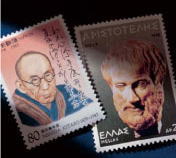
- Philosophy
- History of Western Philosophy
- Japanese Philosophy
- Ethics
- Philosophy of Religion
- Christian Studies
- Aesthetics and Art History
Philosophy
Philosophy has a history of more than two millennia since ancient Greek, making it simply the oldest of mankind’s scholarly pursuits. Today it is not clear, however, how we can pursue and develop this long-standing discipline in the entirely new circumstances of the 21st century.
But we have a clue in the tradition of our department. This department was the home of a distinctive philosophical movement in the 20th century Japan; Kyoto school. The founders of the school, Kitaro Nishida and Hajime Tanabe, served for decades as professors of this department, rearing a host of original and creative philosophers. They were open minded to such diverse intellectual milieu as Western classical and contemporary philosophies, Eastern traditional thoughts, religious experience, science, mathematics, logic, art, practical matters & etc. Against those rich and wide intellectual and cultural backgrounds, they attempted to construct dense and daring philosophical edifices of their own.
In the age of globalization and under the dominance of science/technology, we are in more need than ever for the open-mindedness to various intellectual fields and practical issues. So while researching classical and contemporary Western philosophy, we are always paying serious attentions to such other fields as mentioned above, and seeking to make unique and original philosophical contributions to today’s various problems.
We are also very keen to establish international networks of scholars and students of philosophy and many other disciplines. Through corroborations with newly established institutions in Kyoto University and Graduate School of Letters such as Center for Applied Philosophy and Ethics (CAPE) and Kyoto University Asian Studies Unit (KUASU), we are organizing numerous international workshops, symposiums, exchange of scholars and students, and other research and educational activities. Our emphasis is particularly placed on the establishment of cross-disciplinary intellectual networks in the region of Asia and Pacific.
For PDF version, click this icon. 
| DEGUCHI, Yasuo | Prof. | Epistemology; Philosophy of Statistics; The Philosophy of Kant |
| OTSUKA, Jun | Assoc. Prof. | Philosophy of Science; Philosophy of Biology |
| IGARASHI, Rrosuke | Spec. Lecturer | Philosophy of Logic and Information |
History of Western Philosophy
Three Sub-Departments — those of Ancient Philosophy, Medieval Philosophy and Modern Philosophy, each with a unique tradition, — comprise the department, which is one of the few academic institutions in Japan where students can study the entire span of the history of Western philosophy.
Students of Ancient Philosophy are expected to investigate basic philosophical problems in their historical context, tracing them back to the birth and development of philosophy by reading ancient Greek and Latin texts from the 7th century BC to the 7th century AC.
Students in Medleval Phllosophy will study philosophies from the rise of Christianity in Late Antiquity to the Renaissance. They will be able to experience the heart of the Medieval world that is the immediate origin of today’s Europe primarily through reading Latin texts with precision.
Modern Philosophy students will study the history of philosophy in modern Europe from Descartes onward. Undergraduate and graduate students study together, reading philosophical texts that embody the result of the philosopher’s struggle with the history of philosophy by closely following the authors’ logic.
The undergraduate and graduate programs consist of lectures and seminars, with a greater emphasis on seminars as arenas for training in the accurate reading of original texts in their original languages. Students are thus required to have mastered before enrollment the language used by the philosopher they plan to study. Lectures include both introductory courses designed to provide students with essential knowledge and special lecture courses by full-time and part-time faculty members; the latter also serve as an opportunity for students to become familiar with the faculty’s latest research. Since students are required to prepare a thesis or dissertation to complete their program at each of the undergraduate and graduate levels, we also offer a course in which those students can present drafts to solicit comments and discussions.
Although their numbers are limited, some international students are also enrolled in our graduate programs. On the other hand, more and more Japanese students from the Department now study abroad, while international exchange opportunities within Japan are also on the increase.
For PDF version, click this icon.
| Okochi Taiju | Prof. | Hegel reception in the contenporary pragmatism |
| SUTO, Taki | Prof. | History of Western Medieval Philosophy |
| HAYASE Atsushi | Assoc. Prof | Ancient philosophy |
Japanese Philosophy
Although some Japanese universities have a department or major titled History of Japanese Thought, ours is the only department to be called Japanese Philosophy. Unlike the others, whose primary concern is typically the history of Japanese thought from ancient times through the Middle Ages and into early modern times, our emphasis is on studying how philosophy formed and developed in post-Meiji Japan. What did Japanese thinkers discern when they encountered Western thought and philosophy from the Meiji period onward? Which issues concerned them? How did they create their own in confronting these issues? It is primarily these processes that we delve into.
Our work aims to consider these processes in historical perspective, as well as in relation to the challenges currently faced by us and our times. To accomplish this, however, we believe that it is essential to positively engage in dialogue with foreign ideas and philosophies and contemplate them in an open atmosphere, rather than confining ourselves within the framework of “Japan”.
The department played the central role in the founding of the Forum of Japanese Philosophy, which organizes seminars and international symposia collaborating with scholars of Japanese philosophy in Japan and abroad, for the development of the study of Japanese philosophy and networking with scholars in the field. The forum also publishes the journal Nihon no tetsugaku (Japanese Philosophy) with Showado Press, and the department bulletin, Nihon tetsugakushi kenkyū (Studies in Japanese Philosophy).
For PDF version, click this icon.
| UEHARA, Mayuko | Prof. | Philosophy; Japanese philosophy |
| WIRTZ, Fernando Gustavo | Ass. Prof. | Philosophy of the Kyoto School;Intercultural Philosophy; German Idealism |
Ethics
Created with the foundation of Kyoto Imperial University’s College of Letters in 1906, the Department of Ethics is one of the six oldest departments within the Faculty of Letters. Professor Kōichi Kanō, the first chair of the department who served concurrently as the first dean of the College of Letters, built the foundation for the unique academic culture of Kyoto University’s Faculty of Letters, inviting prominent intellectuals from outside of the academic establishment, such as Konan Naitō and Rohan Kōda, to serve as professors.
The aim of the department is the contemplation of human action from a philosophical perspective, or to study “social philosophy” in the broader sense of that term. Research themes of students may be categorized largely into either ethical theory or applied ethics, but in choosing either one, a student must nonetheless maintain an awareness of the other. Alao, historical studies providing an overview of the entire spectrum of ethical thought are alao important, serving as a filter to separate genuine scholastic study from arbitrary ideas or mere statements of opinion.
Within the department, study sessions and reading circles, organized mostly by graduate students, are held on a regular basis. Students can receive great intellectual stimulus by availing themselves of the opportunity to participate in theses activities. During the summer vacation, students and faculty members join in attending an intensive study camp focusing on a specific theme — an important annual event that also strengthens friendship and communication. Publications from the department include Jissen Tetsugaku Kenkyū, a journal with a history that is a quarter-century long, as well as compilations of source materials produced through several projects and collections of research papers, which serve as references for students in deciding their own research orientations.
For PDF version, click this icon.
| KODAMA, Satoshi | Assoc. Prof. | Philosophy of Communication; Applied Ethics |
| CAMPBELL, Michael | Ass. Prof. | Political Philosophy, Ethics, and Applied Ethics |
Philosophy of Religion
While a wide variety of phenomena may be dealt with under the rubic of religion and there are various academic approaches dealing with them, our basic strategy is to pursue religious questions through philosophical investigations. Underlying this stance is the insight that religion is not simply a matter of exceptional experience, special credo or organization, but a field that questions the origin of our “being-in-the-world” and that of our selfhood. The question “what is religion?” inevitably touches on the fundamental problems of philosophy. That is why we stand at the point where religion and philosophy face with each other while maintaining their difference and try to elaborate the way of thinking required therein. To explore “philosophy of religion” in this sense is the fundamental orientation of our department.
Such an orientation evolved out of the work of former members of the faculty serving within the department, such as Kitarō Nishida, Seiichi Hatano, Keiji Nishitani, Yoshinori Takeuchi, Shizuteru Ueda and Shōtō Hase. This development was often closely correlated with the evolution of the Kyoto School of philosophy. Hence, our curriculum does not offer courses based on descriptive or empirical approaches to religion, such as history, psychology, sociology or anthropology of religion. These categories, however, have not been closed off to our students; rather, researchers in philoeophy of religion have been encouraged in recent years to move more freely to and from such empirical studies. The initial step for students wishing to enrol in this department is to identify where their own interest lies, since that essentially will be what guides students learning in our programs.
For PDF version, click this icon.
| SUGIMURA, Yasuhiko | Prof. | Philosophy of religion (French contemporary philosophy) |
| IBARAGI DAISUKE | Assoc. Prof. | Philosophy of religion |
- http://www.bun.kyoto-u.ac.jp/religion/rel-top_page/ (in Japanese)
Christian Studies
The Department of Christian Studies was founded in 1922 in order that the study of Christianity could be pursued from a purely academic standpoint, which distinguishes the department from Christian theology (divinity) schools tied to a specific faith or dogma. The scope of research and education pursued in the department covers all aspects of the history and philosophy of Christianity.
Christianity, of course, serves as the foundation of the philosophical and cultural traditions of the Western world, and Christianity has spread to many other parts of the world, including Asia and Africa, creating new cultural spheres and influencing all of mankind. To approach an object of study so broad and diverse, we have sought to collaborate with associated disciplines to add many different viewpoints to our education and research pursuits. Methodologies for such studies may include, for example, philological or historical studies based on the reading of texts of great thinkers, fieldwork, or the analyses of Christian artwork (e.g. architecture, paintings, music and literature). Among these, the department places emphasis on research and education in the following fields: Biblical studies, the history of Christian thought (in particular, patristic, Reformation, modern and contemporary Christian thought), systematic studies of Christian thought and studies of Christian though from the viewpoint of religious philosophy).
In addition to regular courses (which include lectures and seminars), students are offered opportunities for active learning through a variety of workshops and reading circles.
For PDF version, click this icon.
| TSUDA KENJI | Prof. | Eariy Christian Thought |
Aesthetics and Art History
The department, which is composed of three fields, i.e. aesthetics and art theory, art history, and comparative art studies, operates on the premise that these three fields are inseparably linked. Students can pursue an extremely broad range of research interests including anything that has been deemed art.
In terms of themes and methodologies, our studies can be classifted roughly into two categories: theoretical studies of art and studies of individual works of art. In theoretical studies, students may explore the essence of art in terms of its origin, its relationship to society, or the nature of various aesthetic experiences such as that of beauty, sublimity, humor and ugliness, using as a starting point various texts on aesthetics and art from ancient times to the contemporary age. In contrast, in studies of individual works of art, students may focus on particular works of art created in Japanese, Eastern or Western cultural contexts, and examine their stylistic features or the circumstances behind their creation and reception. In recent years studies of contemporary art outside the traditional paradigms are on the increase, and as conventional methodologies cannot be easily applied to these works that are in the process of being created, new approaches are being tested. Some undergraduate and graduate students also study film and popular music. In the future, the scope of research endeavors at the department is bound to grow even further in variety and diversity.
For PDF version, click this icon.
| HIRAKAWA, Kayo | Prof. | History of European art |
| SUGIYAMA, Takashi | Assoc. Prof. | Aesthetics and the Philosophy of Art |
| TSUTUI TADAHITO | Assoc. Prof. | History of Japanese Art. |














![Kyodai Ibunkai[in Japanese]](../../wp-content/themes/default/images/leftcolumn/bunner/ibun.gif)

![Gakuseishien Project [in Japanese]](../../wp-content/themes/default/images/leftcolumn/bunner/shien.gif)

![Kyoto Gakuha Archive (of Philosophy in Faculty of Letters, Kyoto University) [in Japanese]](../../wp-content/themes/default/images/leftcolumn/bunner/kyoto-gakuha.gif)





- About
- From Our Dean
- History
- Staff Only (in Japanese)
- Getting to Campus
- Contact
- Attached Facilities
- Library of Graduate School of Letters, Kyoto University
- Center for Studies of Cultural Heritage and Inter Humanities (CESCHI)
- Haneda Memorial Hall
- Center for Applied Philosophy & Ethics (CAPE)
- Asian Research Center for the Intimate and Public Spheres (ARCIP)
-
International Students
- Departments & Staff
-
Division of Philology and Literature
- Eastern
- Japanese Language and Literature
- Chinese Language and Literature
- History of Chinese philosophy
- Indological Studies
- Buddhist Studies
- Western
- Greek and Latin Classics
- Slavic Languages and Literatures
- German Language and Literature
- English/American Language and Literature
- French Language and Literature
- Italian Language and Literature
- Division of Behavioral Studies
- Division of Contemporary Culture
-
Division of the Joint Degree Master of Arts
- Affiliated Organizations
-
Kyodai Ibunkai
[in Japanese] - Projects for Education & Research
-
Gakuseishien Project
[in Japanese] - KYOTO UNIVERSITY ASIAN STUDIES UNIT
-
Kyoto Gakuha Archive (of Philosophy in Faculty of Letters, Kyoto University)
[in Japanese] - Projects completed
-
Kyoto Univ. -
Kyoto University CO-OP
[in Japanese]